The strongest teams I have led shared many of the same qualities.
People understood their roles. They knew where their teammates were strongest and where they needed help. They trusted one another, celebrated success together, and felt connected to something larger than their individual responsibilities.
But underneath all of those qualities was something more basic.
People felt appreciated.
Not simply recognized for completing a task or reaching a goal. They felt valued for what they contributed and for who they were. That distinction matters. Recognition acknowledges an accomplishment. Appreciation strengthens a relationship.
The same is true for customers.
Customers want their problems resolved, but resolution is only part of the experience. They also want to know that their time matters, that their history has not been forgotten, and that the company values the relationship beyond the immediate transaction.
When customers feel appreciated, even ordinary interactions can build trust. When they do not, even an efficient experience can feel cold and transactional.
This becomes especially important as AI takes on a larger role in Customer Support.
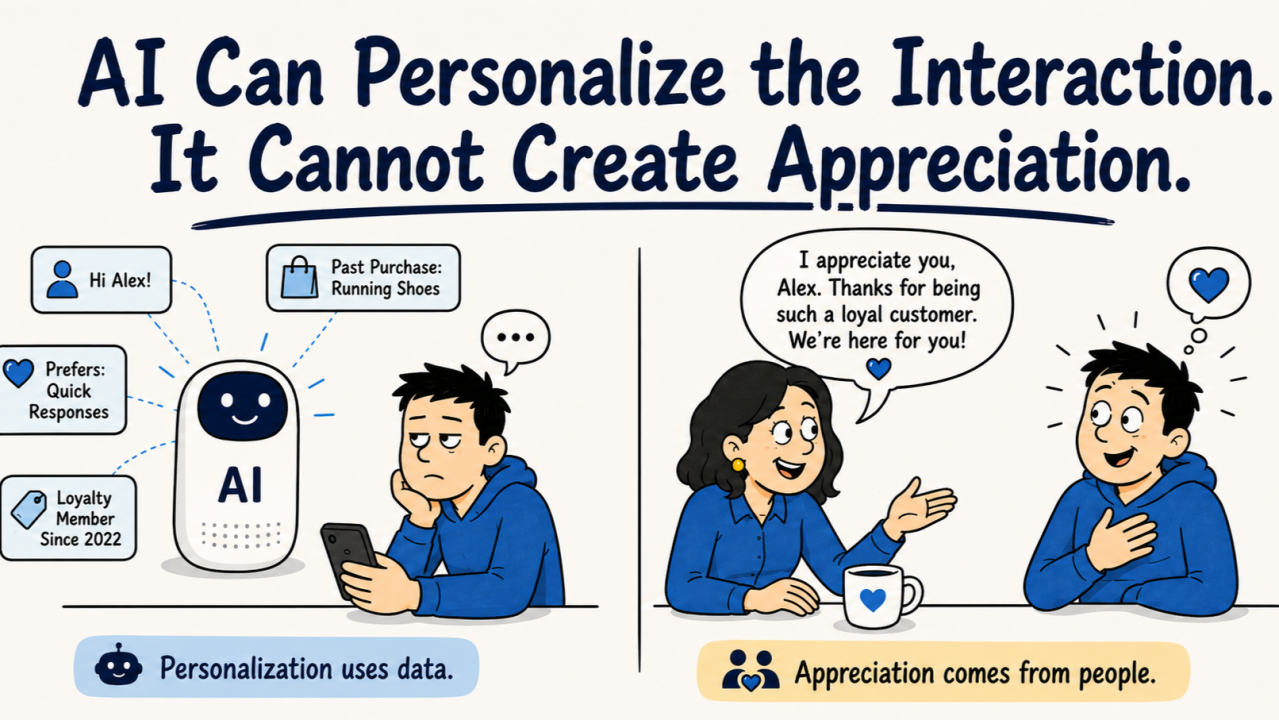
AI can help an organization demonstrate appreciation in ways that were previously difficult to deliver consistently. It can give an agent a clear picture of the customer’s history before the conversation begins. It can preserve context as the customer moves between channels. It can recognize that someone has contacted the company three times about the same problem and make sure they are not asked to begin the story again.
It can also help identify what matters to a particular customer. A support interaction can be informed by the products they use, the goals they are trying to accomplish, the frustrations they have already experienced, and the promises the company has made.
Used thoughtfully, AI can make the customer feel known.
But poorly implemented AI can do the opposite.
It can greet someone by name while ignoring everything they have already said. It can generate a warm-sounding response that never addresses the actual concern. It can force a frustrated customer through another automated exchange because the system has been designed to contain the interaction rather than understand it.
That is not appreciation. It is personalization without a relationship.
Customers can usually sense the difference.
We tend to know when appreciation is genuine because it appears in what an organization chooses to do. It appears when someone remembers the context. It appears when the process respects our time. It appears when a person takes ownership instead of sending us back into the system. It appears when the company responds not only to the request, but to the experience surrounding it.
AI can support all of those moments. But it can only do so when the culture and operating model already value the customer.
A company that sees Support primarily as a cost to be reduced will use AI differently from one that sees every interaction as an opportunity to strengthen the relationship. One will design for containment and efficiency. The other will also ask whether the customer felt heard, respected, and appreciated.
The technology may be identical. The experience will not be.
This is why AI transformation in Customer Support cannot be separated from culture.
Leaders must decide what they want customers to feel when they interact with the organization. They must define what appreciation looks like in practice. Is it remembering context? Reducing effort? Following through on a promise? Recognizing the business impact of an issue? Knowing when a customer needs empathy rather than another automated answer?
Those decisions shape how AI should be designed, measured, and governed.
Efficiency still matters. Customers generally do not want a longer interaction when a shorter one will solve the problem. But speed alone does not create loyalty. A customer can receive a fast answer and still leave feeling like a case number.
The real opportunity is to use AI to make appreciation more consistent, not merely more scalable.
That may mean giving employees better context so they can begin the conversation with understanding. It may mean detecting frustration early enough to change the course of an interaction. It may mean noticing patterns across a customer’s journey and acting before the relationship is damaged.
None of that replaces human connection. It creates better conditions for it.
The organizations that earn lasting customer loyalty will not be the ones that automate the most interactions.
They will be the ones that use AI to show customers, in meaningful and believable ways, that the relationship still matters.