Free First Edition · July 2026
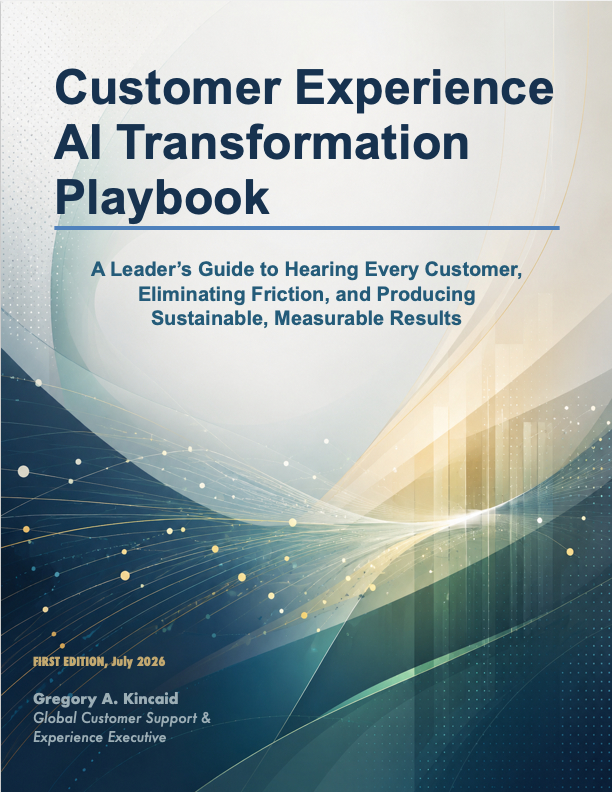
Customer Experience AI Transformation Playbook
AI should help the company hear every customer again.
A practical executive guide for using AI to understand why customer demand exists, reveal recurring friction, strengthen product fit, and turn customer evidence into measurable company change.
Written for COOs, CCOs, Chief Product Officers, and senior Customer Experience, Support, Product, Engineering, and Operations leaders navigating the decisions behind AI transformation.
Unlock the Playbook
Share a few details, then confirm the email we send to open your complimentary copy.
The Central Idea
Do not use AI merely to handle customer demand.
Use AI to understand why the demand exists, reveal where the product or company creates friction, change the underlying conditions, and verify that the customer experience improved.
Efficiency matters. But processing more cases faster is not the transformation. The larger opportunity is to reconnect Customers, Support, Product, and Engineering through a governed evidence system that converts customer interactions into better products, better decisions, and stronger business outcomes.
Why This Playbook
Growth turns customer listening into a problem of scale.
In the early life of a product, leaders often know the customers personally. Complaints, questions, workarounds, and unexpected uses quickly become product input.
As the company grows, those signals scatter across support cases, calls, onboarding work, implementations, customer-success conversations, product telemetry, incidents, surveys, reviews, and renewal discussions.
The company does not necessarily lack data. It lacks connected evidence. Without a shared evidence layer, each function manages its fragment while the company loses the customer’s complete reality.
Can your organization answer these questions continuously?
- Why are customers asking for help?
- Where do real customer workflows become difficult?
- Which friction is recurring across accounts or products?
- Who owns changing the underlying condition?
- Did the intervention reduce effort, recurrence, risk, or lost value?
- Which work should be eliminated, prevented, enabled, augmented, or automated?
From Signals to Company Change
Build a customer-led AI operating model.
01
Restore customer intimacy at scale
Define which customer questions the company must be able to answer continuously—not only during a research project, survey cycle, or executive escalation.
02
Treat every interaction as evidence
Use support, onboarding, implementation, usage, knowledge, incident, escalation, and renewal signals as a distributed customer-research system.
03
Explain why demand exists
Move beyond contact reasons and symptoms to identify the customer goal, workflow step, friction, root cause, accountable owner, and required change.
04
Prioritize friction by consequence
Evaluate friction based on frequency, customer effort, workflow importance, affected cohorts, adoption impact, renewal exposure, and business value.
05
Create accountable ownership
Establish a cross-functional cadence in which evidence is accepted, rejected, investigated, acted upon, and verified with visible rationale.
06
Automate after understanding
Remove unnecessary work, prevent avoidable demand, enable known tasks, augment expert judgment, and automate stable, understood, low-risk work.
Inside the 35-Page First Edition
An operator’s guide—not a catalog of AI features.
Part I
The Lost Customer Learning Loop
Understand how growth separates customer experience from company decisions, why support demand contains strategic insight, and how disconnected signals hide workflow friction, product-fit issues, and renewal risk.
Part II
The Customer Insight Transformation Framework
Establish the correct sequence for Customer Experience AI: Listen ? Understand ? Improve ? Prevent ? Enable ? Augment ? Automate. Move from customer symptoms to workflow context, root cause, accountable change, and measurable verification.
Part III
The Customer-Led AI Operating Model
Design the evidence architecture, taxonomy, governance, human-judgment boundaries, operating cadence, insight standards, and cross-functional decision system required to turn customer signals into company action.
Part IV
The Executive 30/60/90-Day Playbook
Move from intent to execution through a focused operating pilot that defines the first customer question, connects essential evidence, establishes ownership, produces initial insight briefs, and measures customer and business outcomes.
Tools and appendices
- Customer Listening Maturity Assessment
- Customer Insight Brief
- Transformation Scorecard definitions
- Governance and evidence standards
- Operator cases drawn from global customer operations
- Sources and further reading
The Expected Outcome
Customer Experience AI should produce more than lower cost.
- A continuously updated understanding of what customers are trying to accomplish and where their work becomes difficult.
- A defensible explanation of why cases, escalations, implementation delays, adoption barriers, and renewal concerns exist.
- Consolidated evidence about product fit, workflow friction, knowledge gaps, policy obstacles, and service-design failures.
- Prioritized customer insights with affected cohorts, business consequence, confidence, accountable owner, and verification measure.
- A closed loop from customer signal to company decision, corrective action, and measured improvement.
- Automation and employee augmentation applied to the work that remains after underlying friction has been addressed.
- A human-AI operating model that strengthens expertise, preserves access to source evidence, and keeps consequential decisions human-owned.
Download the Customer Experience AI Transformation Playbook
Use it to assess your organization’s current listening maturity, identify the first customer question worth answering, establish cross-functional ownership, and define a practical 90-day transformation pilot.
PDF · 35 pages · First Edition · July 2026
About the Author
Gregory Kincaid
Executive Operator • Independent Advisor • Author
Gregory Kincaid is a global Customer Support and Experience executive who has built, scaled, and transformed complex 24×7 technical customer organizations across products, countries, languages, and regulated environments.
For the past five years, he has implemented AI within live customer operations—not as a substitute for customer understanding, but as a way to scale listening, improve decisions, redesign work, and reduce demand that should not exist.
As an independent advisor, Gregory personally leads every briefing, workshop, assessment, advisory engagement, and speaking program. He works with client leaders and operating teams rather than substituting an external delivery bench for internal ownership.
33%
Monthly support demand reduced through automation, self-service, workflow, knowledge, routing, and product improvement
99%+
SLA attainment while sustaining customer satisfaction at or above 4.6/5 across global operations
$500K
Vendor expense removed while service quality and operating performance improved
70K
End users supported across 32 products, six countries, and seven languages
Continue the Conversation
Where is your organization losing customer learning as it scales?
I work directly with operating leaders who are connecting customer evidence to demand reduction, product improvement, human-AI workflow design, governance, and measurable business change.