Every Support leader eventually faces the same question.
How do you prove that your organization is effective?
The answer usually arrives in the form of a dashboard.
Case volume. First response time. Resolution time. Backlog. Escalations. Customer satisfaction. Cost per contact. Agent productivity.
The numbers are clean, familiar, and easy to compare. They give leaders something concrete to present when the work itself is complex, human, and often difficult to explain.
But numbers do not tell a story on their own.
We tell the story by deciding which numbers matter, how they are interpreted, and what behaviors they reward.
A falling resolution time may mean customers are getting answers faster. It may also mean cases are being closed before the customer believes the issue is resolved.
A rising self-service rate may mean customers are finding what they need with less effort. It may also mean they have learned that reaching a person is too difficult.
A lower cost per contact may reflect a smarter, more efficient operation. Or it may simply mean that more of the effort has been transferred from the company to the customer.
The same metric can support very different stories.
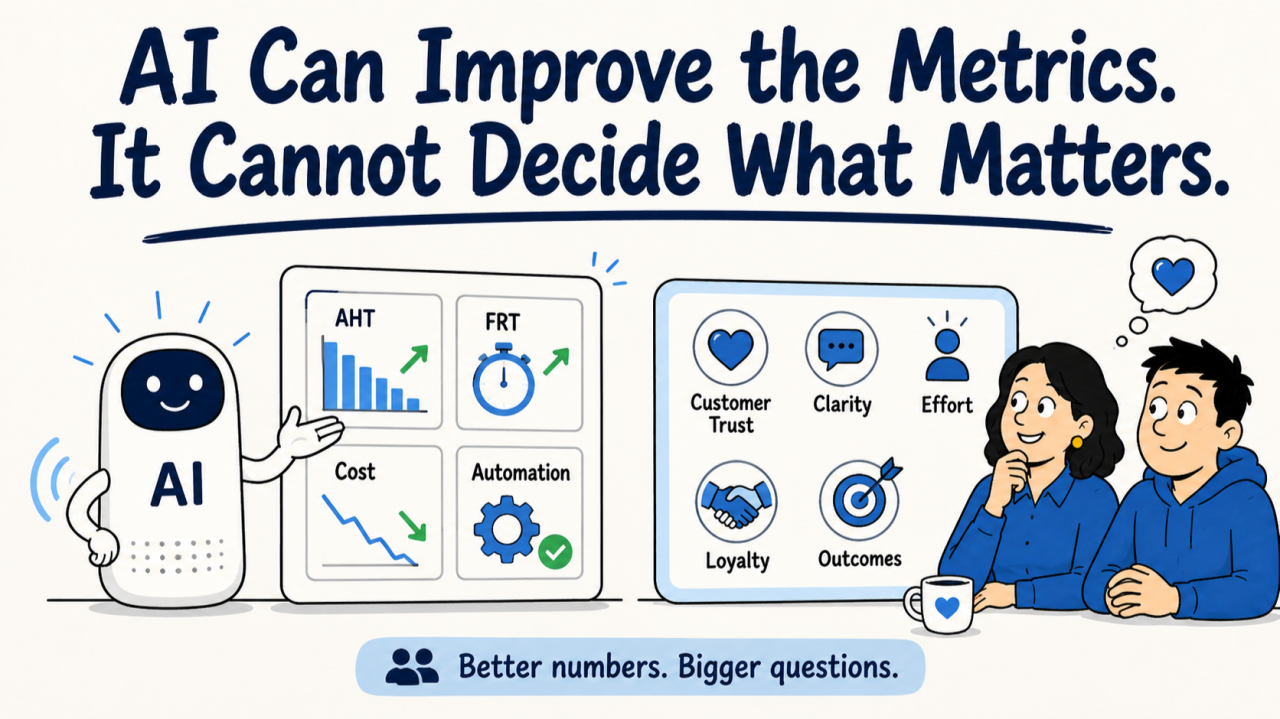
AI makes this challenge more important, not less.
AI can reduce handling time, summarize conversations, automate responses, route work, recommend knowledge, and resolve some requests without an employee becoming involved. Those capabilities create measurable gains, and those gains can be impressive.
But efficiency is not the same as effectiveness.
If the only story we tell about AI is that it lowered cost, reduced headcount, or increased the number of interactions handled, we may be measuring the technology while ignoring the experience it created.
The more important question is whether our metrics reflect the kind of Customer Support organization we are trying to build.
If the customer experience plan promises clarity, ease, and confidence, are we measuring whether customers actually experience those things?
If the team culture values ownership, judgment, and empathy, are our metrics rewarding those behaviors or quietly encouraging employees to move faster and avoid complexity?
If the customer culture is built around long-term relationships, are we measuring the health of those relationships or only the performance of isolated transactions?
Metrics are never merely operational. They communicate priorities.
What leaders measure tells employees what the organization truly values, regardless of what appears in a mission statement.
Tell a team that average handling time is the most important measure, and they will learn to shorten conversations. Tell them that case closure is the goal, and they will learn to close cases. Tell them that automation rate is the proof of AI success, and they will find more interactions to automate.
None of those behaviors are inherently wrong.
The danger appears when the measure becomes disconnected from the experience it was supposed to improve.
That is where AI can either deepen the problem or help us solve it.
Used narrowly, AI gives organizations more ways to optimize the metrics they already have. It can help close cases faster, increase deflection, lower cost, and produce cleaner reports.
Used more thoughtfully, AI can help leaders understand what traditional dashboards have always struggled to show.
It can examine the language customers use across calls, chats, texts, and emails. It can identify recurring friction, changes in sentiment, repeated effort, incomplete resolutions, and patterns across an account’s broader journey. It can connect operational results with product adoption, retention risk, knowledge gaps, and customer confidence.
That creates the possibility of a different kind of measurement.
Instead of asking only how quickly the case was closed, we can ask whether the customer’s effort was reduced.
Instead of counting how many interactions AI contained, we can examine whether the customer received the right outcome.
Instead of treating CSAT as the final word, we can look at the full journey and determine whether confidence improved or deteriorated over time.
Instead of measuring Support only as a cost center, we can show where Support protected revenue, informed product decisions, improved adoption, prevented repeat demand, and strengthened customer relationships.
AI gives us access to a richer story.
But it will not decide which story matters.
That remains a leadership responsibility.
Before adding AI metrics to the dashboard, leaders should return to the customer experience plan. What experience have we promised? What behaviors support that promise? What outcomes matter to the customer, the team, and the business?
Then the measures can be designed to reveal whether the strategy is working.
A strong measurement system will still include efficiency. Cost, speed, capacity, and productivity matter. A healthy organization cannot ignore them.
But those measures need balance.
They should sit beside indicators of customer effort, resolution quality, repeated demand, trust, sentiment, adoption, retention, and the health of the overall relationship.
Otherwise, AI may help us become extraordinarily efficient at delivering an experience customers no longer value.
The most persuasive story a Support leader can tell is not that the organization handled more cases for less money.
It is that the organization created better outcomes for customers, employees, and the business—and can show how each one is connected.
The dashboard will always tell a story.