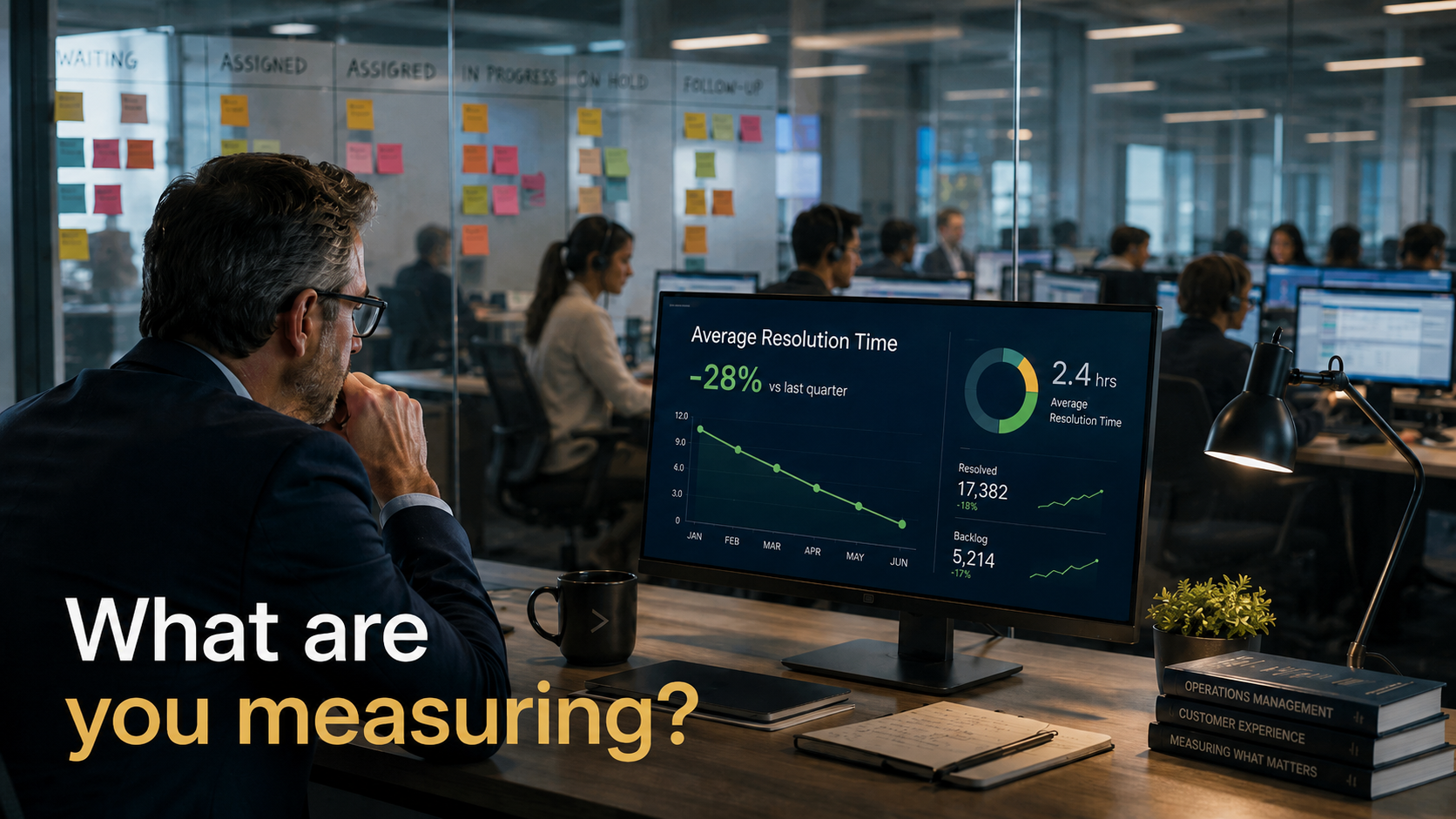
AI Can Accelerate Resolution. But What Are You Actually Measuring?
A support case stays open for three days. The team spends 20 minutes reviewing it, asks for more information, and then waits two days.
Another closes in four hours, but only after a senior technical resource spends two concentrated hours investigating.
Which case was handled more efficiently?
Time to Resolution says the second was faster. It cannot tell us which case required more work, where the time went, how much effort the customer carried, or whether the resolution held.
The Metric Made Sense for the Work
Many support measures inherited their logic from the call center. A call began, an agent handled it, and the call ended. Handle time was imperfect, but elapsed time could reasonably approximate effort.
Modern support is different. One issue may cross email, chat, Support, Product, Engineering, and back to the customer. It may involve several owners, investigation, automation, and long stretches when no one is working.
It is understandable that leaders kept using Time to Resolution. Customers care how long help takes, and teams need to know when cases are stuck.
The problem begins when case age is treated as a complete measure of efficiency.
What the Number Hides
A case can spend most of its life waiting: for the customer, in a queue, for Engineering, or for someone to accept ownership. A fast case can also consume significant expert effort.
The dashboard shows when the clock stopped. It does not show the work, friction, or customer burden inside the clock.
Metrics shape behavior. When speed becomes the objective, teams may close earlier, transfer work, rely on temporary fixes, or improve the number while repeat contacts and product friction remain.
A fast closure is not always a durable resolution.
AI Creates a Better Measurement Opportunity
AI can help separate what one metric compresses. It can distinguish elapsed time from active effort, identify idle periods and unnecessary handoffs, and reveal where customers repeat information.
It can also help leaders look beyond closure. Was the case reopened? Did the workaround hold? Could a product, workflow, documentation, or policy change prevent the demand from returning?
This does not require a larger dashboard. It requires enough detail to understand why performance changed and what action should follow.
Faster responses, higher deflection, and shorter resolution times do not automatically mean a better experience.
The better leadership question is not only, “Did the metric improve?”
It is, “What changed inside the customer’s experience—and did we improve that?”
When Time to Resolution changes in your organization, can you tell what changed inside the case—or only that the clock stopped?
#CustomerSupport #CustomerExperience #AITransformation #SupportMetrics #OperationalExcellence