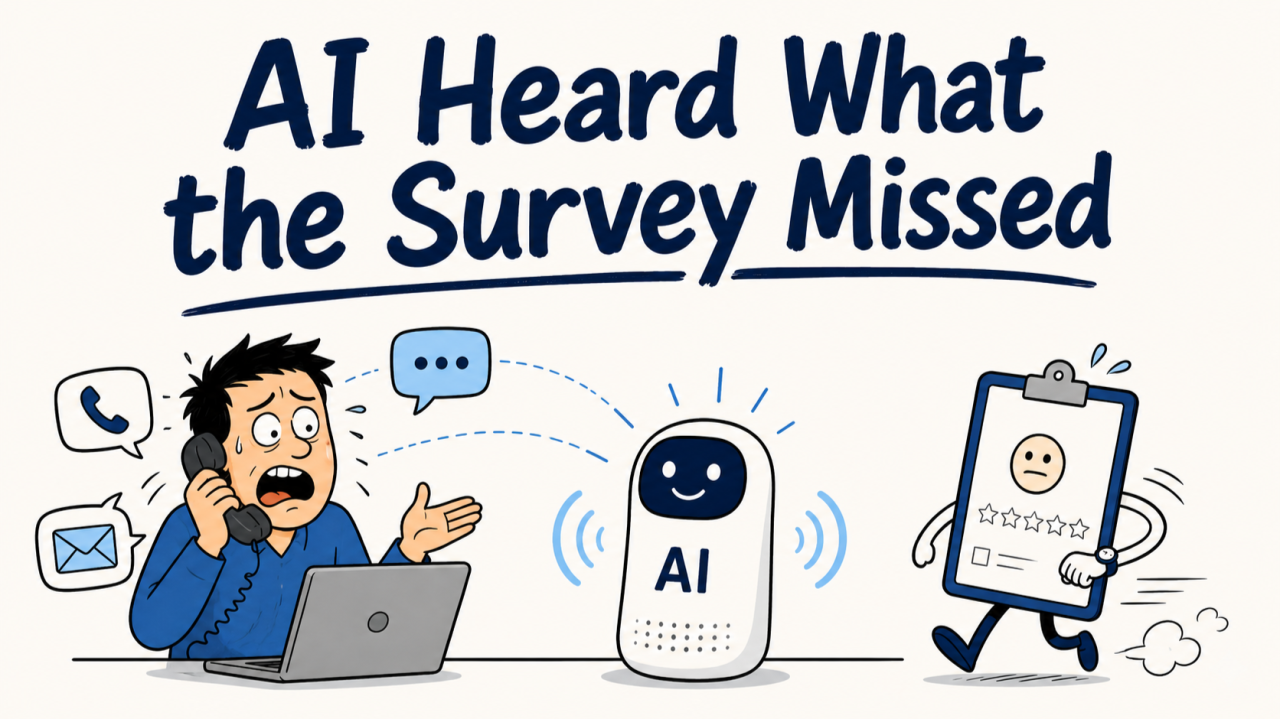
A customer rarely becomes dissatisfied all at once. It usually happens in small moments. A confusing email. A second call about the same issue. A chat where the customer says “that’s fine,” but the words around it say something else. A case update that technically answers the question but leaves the customer no more confident than before.
By the time a CSAT survey arrives, the story is often already over.
And in many cases, the survey never comes back at all.
That has always been one of the weaknesses of traditional customer satisfaction measurement. CSAT and NPS can be useful, but they depend on a small group of customers choosing to respond after the experience has already happened. The loudest feedback is captured. The silent majority is mostly invisible.
AI changes that.
Not by replacing judgment, and not by pretending sentiment analysis is perfect, but by making it possible to listen differently.
Every call, chat, text, and email contains signals. Tone. Frustration. Confusion. Urgency. Repetition. Hesitation. Relief. A customer who is losing confidence often leaves evidence before they ever say they are unhappy.
Near real-time sentiment analysis and topic extraction allow Support teams to see those signals while the journey is still unfolding.
That matters.
It means a leader can see when an account is trending in the wrong direction before the renewal conversation becomes difficult. It means Customer Success can identify where training may be needed before adoption suffers. It means Product can see which workflows are creating friction across many customers, not just the ones who take the time to complain.
The value extends far beyond the individual case.
A single interaction may help resolve one customer’s issue. But when AI connects that interaction to hundreds or thousands of others, the case becomes part of a larger pattern. It can reveal where customers are struggling, where the product is creating confusion, where documentation is not closing the gap, and where a relationship may be at risk.
That is the difference between measuring satisfaction after the fact and understanding customer experience as it is happening.
For years, Support organizations have asked customers to tell us how we did after the case was closed.
AI gives us a chance to hear what they were telling us all along.